

YUP! you are getting a “how to reconstitute peptides” guide brought back to life.
It is unbelievable that I am bringing back this portion of the blog again.
However, I realize that in my youth I was MUCH more ahead of the curve than I thought.
*This post contains affiliate links, infact theres LOADS of them. This takes time to flesh out and my experience is USUALLY a literal pain in my butt, or sides. ALMOST every blue link is an affiliate link or a link to my blog again.*
When it comes to getting a peptide or *research chemical* there’s a glaring issue.
When you get your peptides, you notice something odd about it compared to what you see online.
You have this weird, disc shaped powder.
Not an oil or water that’s ready for use immediately.
As a result, I get a LOT of questions or concerns from people.
Like a lot… so now you get this post.
FAQ’s I get on How to Reconstitute Peptides
Just to name a few common questions I see:
- What do I mix my peptides with?
- How do I know how much solution to use?
- How do I calculate how much of the product I have per use?
- How do I mix my peptides?
- Is there any best practices to keep it shelf stable longer?
I’ll address all of these questions and more below.
Also, In the post I have linked a Peptide Calculator.
“What do I mix my peptides with?”
9/10 the answer is “Bacteriostatic Water.”
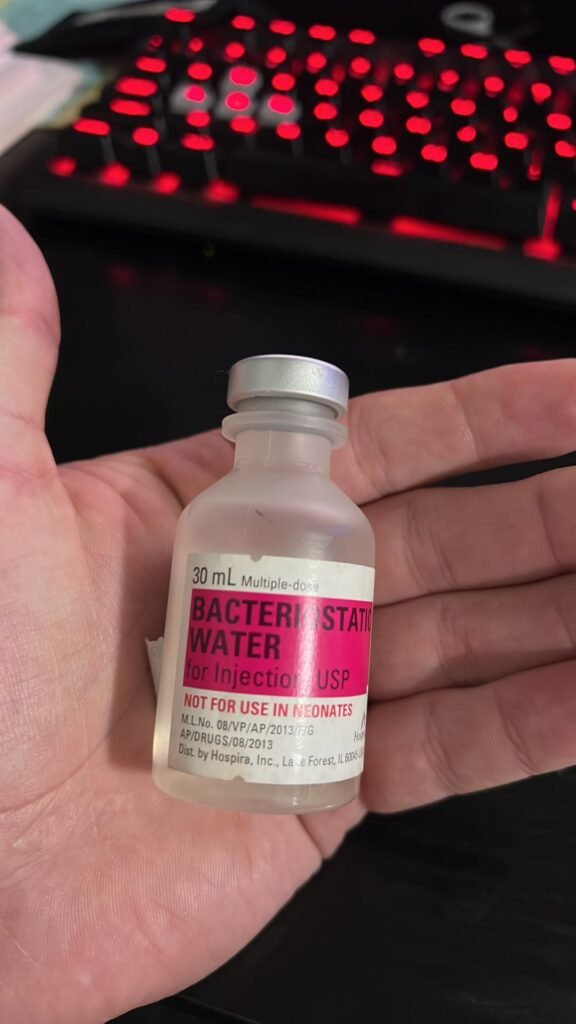

Bacteriostatic water is sometimes colloquially called “Bac Water.”
Sometimes people will receive items in kits with “Sterile water for Reconstitution.”
Other times people will see “Acetic acid for reconstitution”
I’ll talk a bit more about each of these solutions briefly, but 99% of the time.. people use bac water.
why do people use Sterile water for reconstitution?
Sterile water as a solvent for your peptides is typically only in circumstances of SINGLE-use.
This is because properly sealed and stored sterile water is free of bacteria or adulterants.
However; once the vial is used, it now has the opportunity for bacteria or other agents to adulterate the water.
Sterile water is just pure water without any agents to help prevent bacterial growth.
However; Bacteriostatic water or acetic acid which work in slightly different ways to prevent bacterial growth.
Reconstitution with either Bac water or acidic acid is for multiple use products.
why do people use bacteriostatic water for reconstitution
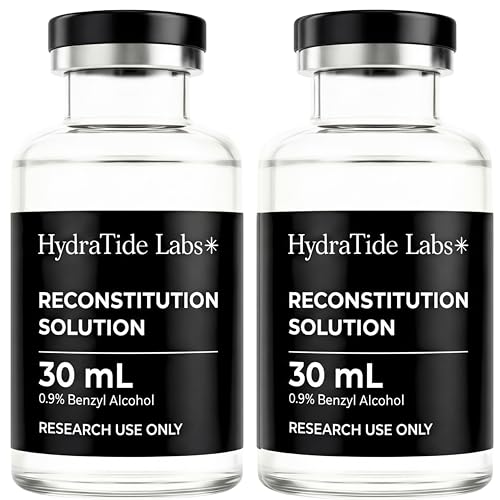
- For Research Use Only – Designed exclusively for research and laboratory procedures. This reconstitution solution is not…
- Deionized Water with 0.9% Benzyl Alcohol – A reconstitution solution made with deionized water and 0.9% benzyl alcohol, …
- Secure Glass Vials – Each 30 mL clear glass vial containing the reconstitution solution is durably made, tightly capped,…

Bacteriostatic water is a solution that typically contains 0.9% “Benzyl Alcohol” per solution as well as sterile water.
The Benzyl Alcohol works to prevent bacterial growth inside of the solution, due to the alcohol.
This also means that the solution created may have a longer shelf life because it won’t be easily degraded by adulterants.
Bacteriostatic water can overtime become worthless, especially after use.
A general rule of thumb people use: after 4 weeks, pitch the opened/used vial.
This is because of the potency from the Benzyl Alcohol is severely impaired from the exposure of other agents.
Why do people use Acetic Acid For Reconstitution?
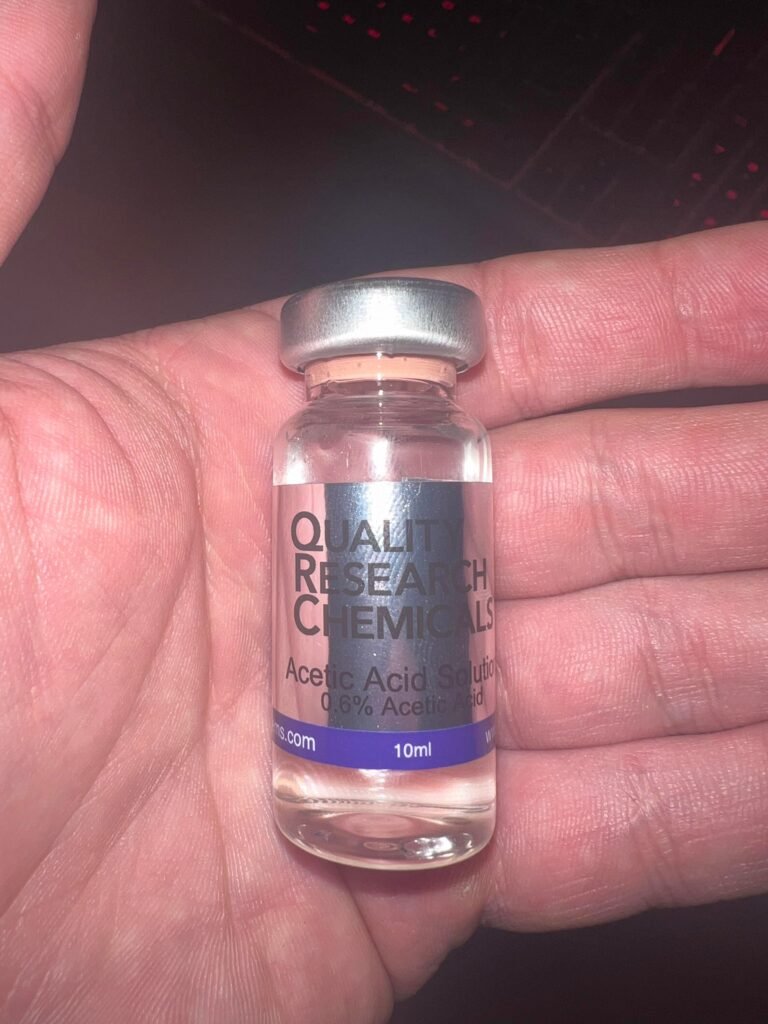

Acetic Acid is a solution that contains 10ml sterile water that is typically diluted with 6mg of acetic acid.
Glacial Acetic Acid is pretty much purified Acetic Acid (it’s less than 1% water content)
It is much more expensive and not necessary.
Typically Acetic Acid is used for more PH sensitive Peptides: (like IGF1-LR3)
The general train of thought is that the alcohol used in bacteriostatic water will denaturize the peptide proteins faster.
As a result, people aim to use Acetic acid for their suspension as it also has a 4 week shelf life.
With acetic acid via Intramuscular or Subcutaneous (subQ) use have issues with a burning sensation.
This is where people will use the acetic acid to reconstitute first, then sterile water or bac water to backfill the syringe before administering.
This dilution occurs AFTER suspension and ONLY in the insulin syringe, not in the vial.
Peptide Reconstitution Calculator
I used to have people check out PinfoBox for peptide calculations, however
I have recently found an OUTSTANDING WEBSITE.
Unlike Pinfobox, they currently do not charge you a monthly fee.
No, I am not affiliated with them, but this is insanely beneficial:
https://peptidecalc.com/# (use this link if website is down)
You can literally pick your syringe size, amount of solution used and the amount you want per injection.
if you don’t have access to the website, here’s an example of the math behind figuring out your injection.
Example: (how much bacteriostatic water to mix with 5mg of bpc-157)
lets say I have a 5mg vial of BPC-157.
Now, if i want to get 250mcg per shot, how would I do that?
I have two of the THREE pieces of information needed.
lets assume i have 1CC (1ml) insulin syringe.
with that I can do an easy calculation.
1000mcg= 1mg
with that, I can do basic multiplication:
(1mg= 1000mcg) x 5 (the amount of BPC-157 in the vial)
5mg= 5000mcg
we know my syringe can hold 1cc/1ml of solution, so that’s not useful YET.
If I add ONE CC (ML) of bacteriostatic water to my BPC-157, I know I’ll have 5000mcg per vial
Now, since I’ve only added ONE ML of Bac water, If I have a 1ML Syringe that will fill it up ENTIRELY.
Each syringe has the amount of “Units” used. (also called TIC marks)
This is used to denote how much you are going to be injecting.
You can typically find 100 TIC mark 1 ML syringes easily on Amazon.
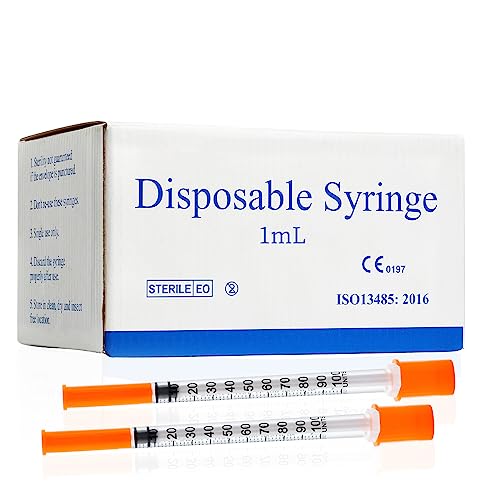
- 【PRODUCT CONTAINS】100pcs U-100 1cc 31G Syringe with 5/16″ (8mm) needles.
- 【SHARP, PAINLESS】These syringes are the sharpest and smoothest can Lower Anxiety During Inject as it is pain-free. These…
- 【BE EASY TO CARRY ABOUT】These come individually-wrapped,Avoid you carry loose syringes in your pocketbook The bottle cap…
They’re going to have every 10 tics denoting a TENTH of a ML.
Now, if I draw to 10 units/ the 10-tick mark I’m using one-tenth of the solution.
That means my injection is 500mcg.
That’s more than I wanted.
So that means I have TWO OPTIONS:
Add 1 more ML of bacterostatic water to get 250mcg per injection
OR just draw in-between half of the 0 and 10 tic marker.
Reconstituting Peptides Step by Step Solution.
Step #1 Use your thumb to take the top cap off from your peptide vial, it should come off easily.
Step #2 Remove the top cap from your Bacteriostatic Water in the same manner.
Step #3. Wipe down both the bacteriostatic water and the peptide vial with an alcohol prep pad.
Step #4. Take an Insulin syringe and load it with bacteriostatic water to the 1ML point
(or draw multiple ML’S if you want to further dilute your peptides)
Step #5. Gently insert the tip of the needle into the center of the rubber stopper on the peptide
then slowly press down on the plunger to allow for a small stream of water to enter the vial.
(Try to not spray a large volume of water directly onto the peptides with force.)
Step #6. Once the desired amount of bacteriostatic water (or acetic acid) has been added into the vial,
take the vial in your palm and roll the vial back and forward gently, like you’re making a play-dough snake. Avoid shaking the vial harshly or in violent motions.
Step #7. After rolling the vial for approximately 10-15 seconds, examine to make sure there is no residual
powder settling at the bottom of the vial or floating at the top.
Step #8. Make sure to keep the vial out of direct sunlight and in a stable climate after it’s reconstitution.
Ideally, they are refrigerated and kept away from food productions to avoid cross contamination or adulteration of the product.
(Video coming soon)
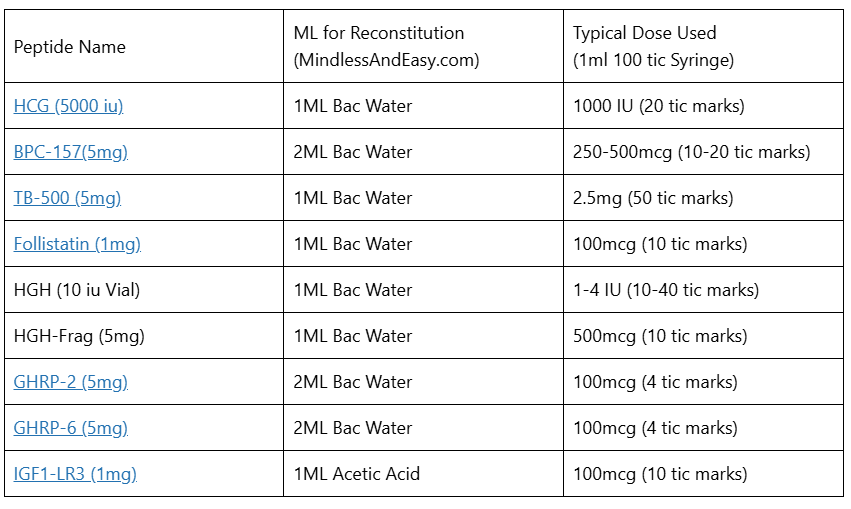
Here is a Simple peptide dilution chart
At the Request of a reader; here is a table with the peptide name, ML of water, and typical dosage utilized.
| Peptide Name | ML for Reconstitution (MindlessAndEasy.com) | Typical Dose Used (1ml 100 tic Syringe) |
| HCG (5000 iu) | 1ML Bac Water | 1000 IU (20 tic marks) |
| BPC-157(5mg) | 2ML Bac Water | 250-500mcg (10-20 tic marks) |
| TB-500 (5mg) | 1ML Bac Water | 2.5mg (50 tic marks) |
| Follistatin (1mg) | 1ML Bac Water | 100mcg (10 tic marks) |
| HGH (10 iu Vial) | 1ML Bac Water | 1-4 IU (10-40 tic marks) |
| HGH-Frag (5mg) | 1ML Bac Water | 500mcg (10 tic marks) |
| GHRP-2 (5mg) | 2ML Bac Water | 100mcg (4 tic marks) |
| GHRP-6 (5mg) | 2ML Bac Water | 100mcg (4 tic marks) |
| IGF1-LR3 (1mg) | 1ML Acetic Acid | 100mcg (10 tic marks) |
Lastly, if you want to SAVE the reference chart, here is a photo to download.
Best practices for longer lasting Peptides.
I talked about this in my previous post where I talk about supplements and their “expiration” dates.
But, if you don’t want to read all of that follow these instructions. (also, ya probably can’t because I haven’t reuploaded them since the first website outage. srry)
- Make sure to wipe down the tops of your vials with an Isopropyl alcohol pad before and after use.
- Do not adulterate your peptides with anything other than your preferred solution.(Bacteriostatic/Sterile water/Acetic acid)
- Refrigerate after reconstitution (keep away from food products)
- Do not let product sit out in direct sunlight
- Do NOT freeze the solution after mixing
- Keep the product out of temperature sensitive climates (don’t let the vial sit out after drawing)
Here are the prep pads I use at home, cheap and get the job done, I have easily purchased over 10,000+ over the past 7 years (they are useful for more than just injections and sterilizing vials):

- STERILE AND INDIVIDUALLY WRAPPED: Each alcohol pad is gamma sterilized and sealed airtight to prevent drying; individual…
- PREP FOR INJECTIONS AND CLEANSING: Alcohol prep wipes are ideal for preparing skin for injections or general cleaning; s…
- STERILE ALCOHOL PREP PADS: Made from medium 2-ply material, each sterile alcohol prep pad measures 1.18 x 2.36 inches; i…
If you have any additional questions or concerns, just let me know.
I don’t think you should though, I’ve already given you a peptide reconstitution chart, a peptide mixing calculator, a peptide dilution guide and your bacteriostatic water to peptide ratio for the ones I see most frequently. I even went the extra mile to put it into mcg per dose for you.. if you are still struggling, then please comment below so other people who tend to just lurk on forums may also get their questions answered and not feel as equally frustrated.
I really try to be as accommodating as possible and I fully understand this gets a little frustrating, but I do try my best without being super harsh all the time.
If you want me to add a peptide to this list, just ask and i’ll put in the table to make your life… MindlessAndEasy (uh… dot com ba dum tss)
Toodles!
Links to items discussed for peptide reconstitution:
Syringes mentioned in blogpost (Click here)
Link to inexpensive bacteriostatic water (Click here)
Link to Acetic Acid (click here)
Additionally, if you use swisschems for your peptides, save 10% on your order using code VG11!




Leave a Reply